HISTORIA
San Pedro de Mérida debe su nombre a la primera iglesia fundada en honor a San Pedro; situado en las proximidades de Mérida de la que dista 15 km, sobre el antiguo camino real de Badajoz a Madrid, hoy carretera NV y Autovía A5.
Linda al este con Torrefresneda, al norte con el Parque Natural de Cornalvo, al oeste con Mirandilla y Trujillanos y al sur con Valverde de Mérida; situándose en esta zona el Río Guadiana.
Pertenece a la comarca de Tierra de Mérida-Vegas Bajas.
Si algo ha caracterizado a San Pedro de Mérida a lo largo de su historia, es que ha sido y es un punto estratégico de paso y encrucijada de caminos, calzadas y carreteras que no solo se han usado por el ganadero trashumante o comerciante de a pie, si no que reyes como Don Rodrigo, Don Sebastián de Portugal y Carlos IV han pasado y pernoctado en esta localidad o ministros ilustrados como Campomanes fijaron su residencia.
Su historia se remonta a la época calcolítica, con ocupación romana y fundación de un complejo monacal en época visigoda. Los árabes explotaron los terrenos de Torrecaños y desde la Edad Media con el Camino Mozárabe es zona de paso de peregrinos hacia el norte. Con la Reconquista formará parte de la Encomienda de Mérida hasta que se independiza en 1835.
NATURALEZA
El Parque Natural de Cornalvo (13.143,4 has) fue declarado Parque Natural en 1993 y en el 2004 se incluyó en la red de espacios naturales protegidos de Extremadura.
Está dominado por las dehesas de encinas y de alcornoque. Uno de los elementos más representativos es la presa romana (en época de Augusto), que sigue siendo utilizada para el abastecimiento de agua de varios municipios. En 1912 fue declarada Monumento Nacional.
Entre su variada fauna se encuentran algunas especies endémicas del Guadiana y sus afluentes, como las colmillejas, las bogas, las pardillas o el jarabugo; el sapo partero ibérico (que solo se haya dentro del planeta en las cuencas de los ríos Tajo y Guadiana) y una especie cercana a la extinción como es el gato montés.
Aves como la cigüeña negra y el halcón abejero destacan por su escasa presencia en Europa e incluso en el resto del mundo desde el punto de vista ornitológico.
Dentro del Parque se afinca el cortijo de Campomanes.
RUTAS SENDERISTAS
En San Pedro se conocen caminos con historia como la Calzada romana de Mérida-Córdoba, el Cordel de San Pedro y la Vereda de Fresneda que enganchan con la Cañada Real Santa María de Araya, el Antiguo camino real Badajoz-Madrid, la actual Autovía A-5…
El camino Mozárabe es una de las rutas de peregrinaje más antiguas de la Península Ibérica, pasa por San Pedro y Trujillanos hasta llegar a Mérida, donde enlaza con la Vía Plata hasta Santiago de Compostela. Otro camino de peregrinación nos lleva desde la localidad a Guadalupe y varias rutas por Cornalvo aprovechando la luna llena de verano.
CAMINO ROMANO A GUADALUPE
Este camino es heredero de la antigua calzada romana que unía Mérida con Toledo, los orígenes de esta calzada romana se remontan probablemente a un antiguo camino tartésico.
A partir del siglo XV, el viejo camino recuperará un esplendor superior al que tuvo bajo el Imperio Romano, al convertirse Guadalupe en el mayor centro de peregrinación de cuantos hubiera en la Península.
La primera etapa del Camino Romano a Guadalupe empieza en Mérida y finaliza en San Pedro de Mérida. La segunda etapa del mismo empieza en San Pedro de Mérida y finaliza en Santa Amalia.
Sin lugar a dudas los mayores impulsores y protagonistas de este camino fueron Isabel I de Castilla y Fernando V de Aragón.
CAMINO MOZÁRABE
El conocido Camino Mozárabe lo utilizaban los cristianos que vivían en los reinos árabes para enlazar con la Vía de la Plata hasta Santiago de Compostela, siendo una de las rutas más antiguas del Camino de Santiago.
La dominación musulmana iniciada a principios del siglo VIII sobre buena parte del territorio peninsular acabaría marcando la vida religiosa de los habitantes del antiguo reino cristiano visigodo. Así, cuando se difunde la noticia del hallazgo del sepulcro del Apóstol Santiago en Galicia los cristianos que vivían en los territorios dominados por los musulmanes intentarían peregrinar hasta Compostela. Estos cristianos recibieron el nombre de mozárabes y consiguieron perseverar en su fe.
En San Pedro de Mérida se da el final de la etapa que comienza en Medellín y el inicio de la etapa que finaliza en Mérida, donde enlaza con la Vía de la Plata hasta Santiago de Compostela.
IGLESIA DE SAN PEDRO APÓSTOL
Obra del siglo XVI con intervenciones posteriores. Está aneja a la antigua basílica visigoda. Es de mampostería encalada y presenta planta de una sola nave con testero plano y cabecera cuadrangular. Destaca la portada del Evangelio, con arco de medio punto renacentista, y pequeña hornacina con una imagen de San Pedro Apóstol. La torre fachada, a los pies, se estructura en dos cuerpos separados por imposta y encalados. En el segundo cuerpo se sitúa un campanario rematado por chapitel con pinaculillos en las esquinas.
VIRGEN DE LA ALBUERA
La Virgen de La Albuera que también se conoció como Virgen de la Cañada; encabeza el Retablo Mayor de la parroquia de San Pedro Apóstol.
La talla es de comienzos del siglo XVI y es de estilo gótico-renacentista. Apareció sobre una higuera en las inmediaciones de la albuera de Cornalvo, de ahí su nombre, donde se construirá una ermita de la que hoy no queda nada. Se traslada a la parroquia en 1835. En 1919 se le añade el pedestal de gloria. Posee un ajuar, y su corona y el bastón de mando datan de 1952. Los bienes de su Hermandad fueron desamortizados en el siglo XIX. Procesiona el Lunes de Pascua.
BASÍLICA VISIGODA
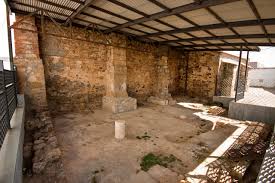
Es uno de los escasos restos de esa época que se conservan en Extremadura. Con ábside cuadrado de sillares de granito, tiene una pila bautismal rectangular de escaleras enfrentadas (baptisterio de inmersión) Conserva los arranques de granito de las columnas, también restos de la pared de mampostería y de una tumba antropomorfa, así como el pavimento original. Actualmente se encuentra rehabilitada con un cerramiento de verja metalizada así como iluminación y es visitable todo el año. Podría haber pertenecido a un complejo monacal fundado por el Abad Nuncto (Vida de los Santos Padres de Mérida, siglos VI y VII) y pudo ser refugio del último rey godo Don Rodrigo, tras la batalla de Guadalete en 711, en su huida a Portugal.
EL MOLINO
Se levantó en el siglo XVII en el brazo derecho del río Guadiana el actual. El edificio perpendicular a la corriente, es rectangular, con una puerta de entrada en la orilla derecha y otra en la pared opuesta. Las paredes son robustas, gruesas y resistentes, de mampostería. El techo está cubierto por una gran bóveda de ladrillos. En la base de la pared, se abren tres canales, uno por cada muela, con compuertas de hierro, por donde entraba el agua que circulaba hasta el mecanismo de molienda.
EL MERENDERO
Zona de recreo a la que se llega pasando el cementerio municipal. Forma parte de la Dehesa y está acondicionada para la romería de San Isidro y otros eventos. El fin de semana más próximo al 15 de mayo sale en procesión la imagen del santo en una carroza, hasta la ermita. Se oficia misa y posteriormente se celebra la romería.
Aquí se ha levantado la nueva Ermita de San Isidro.
ARQUITECTURA POPULAR
La casa típica de planta baja, con ventanales enrejados y un alto llamado doblao es el ejemplo más típico de arquitectura popular de la localidad. El pasillo central, es el eje vertebrador de la casa, desde donde se distribuyen las habitaciones, algunas con alcobas. Se accede por un zaguán o portón y los techos son de bóvedas. Se les adosaban las cuadras y en los traseros estaban los corrales. Algunas tenían pozos, hornos y con chimeneas donde cocinaban.
LA FUENTE NUEVA
Había sido abrevadero para el ganado y aunque no es potable, también abastecía a la población.
ESTATUA DE SAN PEDRO APÓSTOL
Se le dedicó una avenida al escultor más importante en la historia de Extremadura y uno de los más importantes del siglo XX español, Don Juan de Ávalos García-Taborda. En agradecimiento al pueblo de San Pedro de Mérida, generoso y desprendido, donó este bajorrelieve de San Pedro Apóstol que se instaló sobre un monolito de granito a la entrada del pueblo.
FIESTAS
Fiestas Patronales en Honor a Ntra. Sra. de La Albuera
Coinciden con la Semana Santa. Misa extremeña y procesión el Lunes de Pascua y el martes se celebra la romería de “El Mamao”
Fiestas de San Isidro.
Se celebra el fin semana más próximo al 15 de mayo en “El Merendero”. Traslado del santo en carroza y misa.
Fiestas de San Pedro Apóstol
Se celebra el fin de semana más cercano al 29 de junio. Tarde-noche de convivencia y baile en la plaza.
Fiestas del Emigrante
Se celebra el fin de semana más próximo al 15 de agosto. Tradicional concurso de calderetas, charanga y baile en la plaza.
GASTRONOMÍA
Comparte recetario con el resto de pueblos de la comarca, siendo muy típica la caldereta de cerdo o cordero, así como los embutidos de la matanza del cerdo.
Destaca la repostería local, siendo muy conocidas las empanadillas rellenas de bizcocho.
DÓNDE COMER Y DORMIR
San Pedro actualmente es una zona de paso en la A-5 Madrid-Lisboa y los viajeros pernoctan en la localidad. Destacamos el Área de Servicio con establecimientos hosteleros, gasolinera, y bar-restaurante-cafetería.
COMER:
Restaurante Kavanna
Avenida Juan de Ávalos. Tel: 924 325 022
Restaurante Área de Servicio Ruta 5
Avenida Juan de Ávalos. Tel: 924 325 151
Restaurante Juan Porro
Avda. Juan de Ávalos,5. Tel: 924 325 010
Bar-Churrería Entre las Encinas
Avda. Juan de Ávalos. Tel: 625 536 576
Bar del Pensionista
Avda. Virgen de La Albuera
DORMIR:
Hostal Kavanna
Avenida Juan de Ávalos. Tel: 924 325 022
Hostal Juan Porro
Avda. Juan de Ávalos, 5. Tel: 924 325 010
Pensión Josema
Avda. Virgen de La Albuera, 40. Tel: 688 471 329
HISTORY
San Pedro de Mérida owes its name to the first church founded in honour of San Pedro; located near Mérida, 15 km away, on the old royal road from Badajoz to Madrid, currently NV road and A5 motorway.
It borders with Torrefresneda in the east, Cornalvo Natural Park in the north, Mirandilla and Trujillanos in the west and Valverde de Mérida in the south. It belongs to the region of Tierra de Mérida-Vegas Bajas.
Since its origin, the location of San Pedro de Mérida as strategic point of passage and crossroads of roads, roads and highways has been used by the transhumant farmer or merchant on foot. Kings like Don Rodrigo, Don Sebastián de Portugal and Carlos IV have spent the night in this locality, also enlightened ministers like Campomanes established their residence there.
Its history goes through the Chalcolithic period, with Roman occupation and the foundation of a monastic complex in the Visigothic period. The Arabs exploited the land of Torrecaños and built the Mozarabic Way is a passageway for pilgrims to the north of Spain. During the Reconquest, San Pedro became part of the Encomienda de Mérida until its independence in 1835.
NATURE
The Cornalvo Nature Reserve (13,143.4 hectares) was declared Nature Reserve in 1993 and in 2004 it was included in the network of protected natural areas in Extremadura.
Consisting in meadows of holm oaks and cork oaks. One of the most representative elements is the Roman dam (in Augustus’ time), which is still used to supply water to several municipalities. In 1912 it was declared a National Monument.
Among its varied fauna there are some endemic species of the Guadiana River and its tributaries, such as the tusks, the bogas, the pardillas or the jarabugo; the Iberian midwife toad (which is only found within the planet in the basins of the rivers Tagus and Guadiana) and species close to extinction as the wildcat.
Birds such as the black stork and the honey buzzard stand out for their scarce presence in Europe and even in the rest of the world from an ornithological point of view.
Inside the Reserve we can see the farmhouse of Campomanes.
HIKING TRAILS
In San Pedro are known paths with history as the Roman road of Merida-Córdoba, the Cordel de San Pedro and the path of Fresneda that connect with the Cañada Real Santa Maria de Araya, the old royal road Badajoz-Madrid, the current highway A-5…
The Mozarabic Way is one of the oldest pilgrimage routes in the Iberian Peninsula, passing through San Pedro and Trujillanos to Merida, where it connects with the Via Plata to Santiago de Compostela. Another pilgrimage route takes us from the locality to Guadalupe and several routes through Cornalvo taking advantage of the full moon in summer.
ROMAN ROAD TO GUADELOUPE
This road is heir to the old Roman road that linked Merida with Toledo. The origins of this Roman road probably go back to an old Tartessian road.
From the 15th century onwards, the old road will regain a greater splendour than it did under the Roman Empire, when Guadeloupe became the largest pilgrimage centre of all those on the Peninsula.
The first stage of the Roman Road to Guadalupe begins in Mérida and ends in San Pedro de Mérida. The second stage begins in San Pedro de Mérida and ends in Santa Amalia.
Without a doubt, the main promoters and protagonists of this route were Isabel I of Castile and Fernando V of Aragon.
MOZARABIC PATH
The well-known Mozarabic Way was used by the Christians who lived in the Arab kingdoms to connect with the Silver Route to Santiago de Compostela, being one of the oldest routes on the Way of Saint James.
The Muslim domination begun at the beginning of the 8th century over a good part of the peninsular territory would end up marking the religious life of the inhabitants of the ancient Visigothic Christian kingdom. Thus, when the news of the discovery of the tomb of the Apostle Santiago in Galicia spreads, the Christians who lived in the territories dominated by the Muslims would try to make a pilgrimage to Compostela. These Christians received the name of Mozarabs and managed to persevere in their faith.
In San Pedro de Mérida there is the end of the stage that begins in Medellín and the beginning of the stage that ends in Mérida, where it connects with the Via de la Plata to Santiago de Compostela.
CHURCH OF ST. PETER THE APOSTLE
Work of the XVI century with later interventions. It is annexed to the old Visigoth basilica. It is made of whitewashed masonry and has a single nave with a flat front and quadrangular head. The portal of the Gospel stands out, with a Renaissance semicircular arch and a small niche with an image of Saint Peter the Apostle. The façade tower, at the feet, is structured in two bodies separated by imposts and whitewashes. In the second body there is a bell tower topped by a chapitel with pinaculillos in the corners.
VIRGIN OF THE ALBUERA
The Virgin of La Albuera, also known as Virgen de la Cañada, heads the Main Altarpiece of the parish of San Pedro Apóstol.
The carving dates from the beginning of the 16th century and is in the Gothic-Renaissance style. It appeared on a fig tree in the vicinity of the albuera of Cornalvo, hence its name, where a hermitage will be built of which today nothing remains. It was moved to the parish in 1835. In 1919 the pedestal of glory was added. It has a trousseau, and its crown and baton date from 1952. The assets of his brotherhood were confiscated in the nineteenth century. Procession on Easter Monday.
VISIGOTH BASILICA
It is one of the few remains from that period that are preserved in Extremadura. With a square apse of granite ashlars, it has a rectangular baptismal font with facing stairs (immersion baptistery). It preserves the granite uprising of the columns, as well as the remains of the masonry wall and an anthropomorphic tomb, as well as the original pavement. It is currently restored with a metal fence and lighting and can be visited all year round. It could have belonged to a monastic complex founded by Abbot Nuncto (Life of the Holy Fathers of Mérida, 6th and 7th centuries) and could have been the refuge of the last Gothic king Don Rodrigo, after the battle of Guadalete in 711, when he fled to Portugal.
THE MILL
It was built in the seventeenth century in the right arm of the river Guadiana the current. The building perpendicular to the current is rectangular, with an entrance door on the right bank and another on the opposite wall. The walls are robust, thick and resistant, made of masonry. The ceiling is covered by a large brick vault. At the base of the wall, three channels are opened, one for each grinding wheel, with iron gates, through which the water that circulated to the grinding mechanism entered.
THE MERENDERO
Recreation area that can be reached through the municipal cemetery. It is part of the Dehesa and is conditioned for the San Isidro pilgrimage and other events. On the weekend closest to the 15th of May, the image of the saint is paraded in a carriage to the hermitage. Mass is officiated and later the pilgrimage is celebrated.
Here the new San Isidro Hermitage has been erected.
FOLK ARCHITECTURE
The typical ground-floor house, with trellised windows and a high so-called doblao is the most typical example of popular local architecture. The central corridor is the backbone of the house, from where the rooms are distributed, some with bedrooms. Access is through a hallway or gate and the ceilings are vaulted. The stables were attached to them and the corrals were in the back. Some had wells, ovens and chimneys where they cooked.
THE NEW FOUNTAIN
It had been a watering place for livestock and although it is not drinkable, it also supplied the population.
STATUE OF ST. PETER THE APOSTLE
An avenue was dedicated to the most important sculptor in the history of Extremadura and one of the most important sculptors of the 20th century in Spain, Don Juan de Ávalos García-Taborda. In gratitude to the town of San Pedro de Mérida, generous and detached, he donated this bas-relief of San Pedro Apóstol that was installed on a granite monolith at the entrance to the town.
PARTIES
Patron Saint Festivities in Honour of Our Lady of La Albuera
They coincide with Holy Week. Extremadura Mass and procession on Easter Monday and on Tuesday the «El Mamao» pilgrimage is celebrated.
Festivals of San Isidro.
It is held the weekend closest to 15 May in «El Merendero». Transfer of the saint in float and mass.
Festivals of San Pedro Apóstol
It is held on the weekend closest to 29 June. Evening-night of conviviality and dance in the square.
Emigrant Festivities
It is held on the weekend closest to 15 August. Traditional contest of calderetas, charanga and dance in the square.
GASTRONOMY
It shares a recipe book with the rest of the villages in the region, with pork or lamb stew being very typical, as well as the sausages from the pig slaughter.
It emphasizes the local confectionery, being very well-known the empanadillas stuffed with sponge cake.
WHERE TO EAT AND SLEEP
San Pedro is currently a transit area on the A-5 Madrid-Lisbon and travellers spend the night in the locality. We highlight the Service Area with catering establishments, petrol station, and bar-restaurant-cafeteria.
WHERE TO EAT:
Kavanna Restaurant
Juan de Ávalos Avenue. Tel: 924 325 022
Área de Servicio Ruta 5 Restaurant
Juan de Ávalos Avenue. Tel: 924 325 151
Juan Porro Restaurant
Avda. Juan de Ávalos, 5. Tel: 924 325 010
Bar-Churrería Entre las Encinas
Juan de Ávalos Avenue. Tel: 625 536 576
Pensioner’s Bar
Virgen de La Albuera Avenue
WHERE TO SLEEP:
Kavanna Hostel
Juan de Ávalos Avenue. Tel: 924 325 022
Juan Porro Hostel
Juan de Ávalos Avenue, 5. Tel: 924 325 010
Pension Josema
Virgen de La Albuera Avenue, 40. Tel: 688 471 329

