Próximo a la orilla izquierda del río Guadiana, sobre una extensa llanura rodeada de sierras, se asienta la localidad de Villagonzalo. Pertenece a la comarca de Tierra de Mérida-Vegas Bajas y al Partido Judicial de Mérida, situándose a 22 km de ésta.
Su fundación como aldea dependiente de la Encomienda de Alange, se atribuye en el siglo XIV al Maestre santiaguista Gonzalo Mexía, de quien deriva su apelativo.
En 1588 se independizó de este dominio mediante el pago de 7.000 ducados a Felipe II, tomando su Privilegio de Villazgo y quedando exenta de dicha Encomienda.
Sus habitantes adquieren el gentilicio de “villagonzalenses” pero son comúnmente más conocidos como “galapagueros” debido a “Las Galapagueras”; tierras de uso exclusivo para los ganaderos de la localidad.
Es un pueblo agrario en el que abunda la zona de regadío y también el olivo. Sus calles son anchas, destacando su arquitectura vernácula con algunas casas solariegas.
MONUMENTOS
IGLESIA PARROQUIAL NUESTRA SEÑORA DE LA PURÍSIMA CONCEPCIÓN
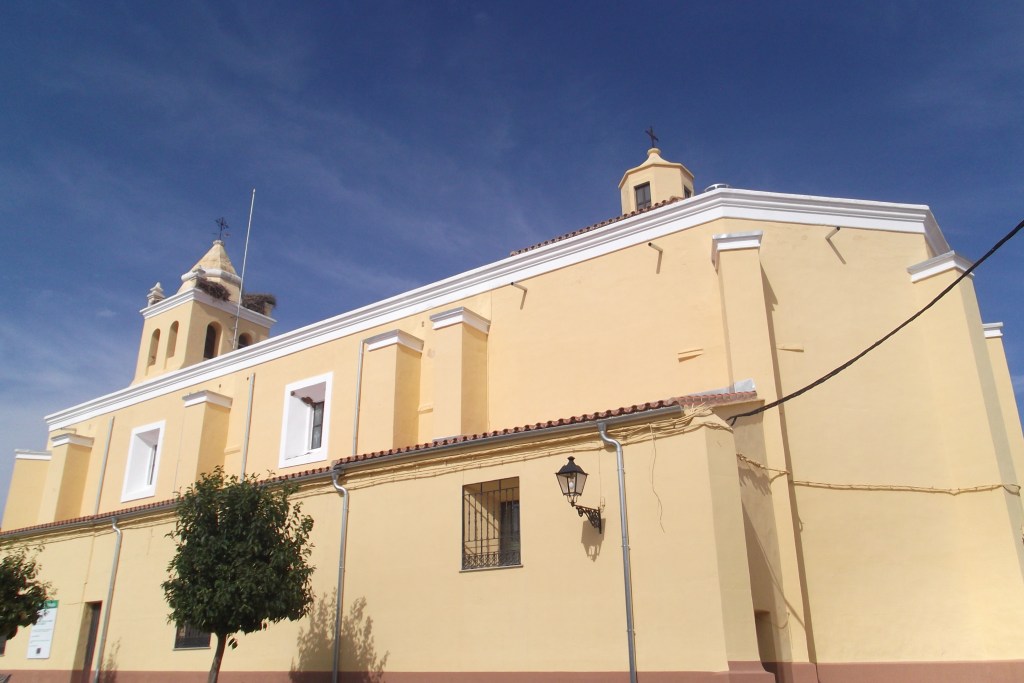
Entre los monumentos locales, el más destacado es la iglesia parroquial de Ntra. Sra. De la Purísima Concepción, obra del siglo XVI, realizado por Domingo Dorego, consta de una nave única dividida en dos tramos, con bóvedas de cañón y cabecera poligonal. Modificada sustancialmente en el siglo XVIII; y reconstruida casi por completo tras la Guerra Civil. En el interior, resulta de interés la puerta de la sacristía, de sencillo diseño clásico con frontón coronado por el escudo santiaguista. También en la Iglesia podemos encontrar la imagen del Cristo Nazareno, patrón de la localidad y obra temprana del escultor extremeño Juan de Ávalos. La importancia de esta obra es que pertenece a la primera etapa del escultor. La imagen del Cristo no es la original, la antigua imagen fue quemada en la plaza en la Guerra Civil.
Señalar además el retablo mayor, obra moderna, de pequeñas proporciones y digna factura, realizada según los modelos barrocos.
En muros exteriores se observan la construcción de 10 contrafuertes de sección cuadrangular, efectuados en sillares de granito. Todo el exterior está pintado de un color ocre muy característico.
PLAZA DE ESPAÑA-COLUMNA TESTUDINIS
En el centro de la plaza de España, ubicada frente al Ayuntamiento, se encuentra la columna Testudinis, más conocida como el monumento al Galápago, creada por el pintor y escultor, descendiente de la localidad, Luis Ledo González en el año 1998. Esta obra fue inaugurada el 2 de agosto del año 2000.
Consta de un monolito de piedra que sirve de basamento, donde puede leerse: “Por cuanto concedo a Villagonzalo de la Orden de Santiago, privilegios de arbitrios en El Pardo. Anno MDCXXXIII, Philippo IV”.
Sobre esta base hay una columna de acero inoxidable con pivotes salientes a lo largo de toda ella y, en su cima, acabada en rampa, descansa la escultura de un galápago realizado en bronce, símbolo del apelativo de los vecinos.
ARQUITECTURA POPULAR
La arquitectura vernácula típica de las casas de la localidad se trata de casas de planta baja y doblado, -entre ellas algunas Casas Solariegas- anteriores al siglo XIX las más antiguas. También edificios más modernos de finales del siglo XIX y primeras décadas del pasado siglo XX, representativos de las nuevas corrientes estéticas y ornamentales, que el “modernismo” aportó en la arquitectura de los nuevos edificios.
ESTACIÓN DE FERROCARRIL
El edificio dedicado a la antigua estación de ferrocarril construida en 1866 cubría la línea Renfe de Madrid-Badajoz. Actualmente se encuentra en desuso, aunque el ferrocarril sigue realizando su trayecto.
IMPORTANCIA DEL AGUA
Desde el siglo XIX se construyeron edificios acuíferos en la periferia y en el casco urbano del pueblo y así acercar el agua procedente del rio y de los arroyos para su uso doméstico y agrícola-ganadero.
La mayor construcción a destacar fue el edificio llamado “La Huerta del Agua”; que constaba en su conjunto de aljibe, noria, pozo y pilar.
EL PILAR DE LAS MONJAS
Construida en el año 1833, de planta rectangular. Edificado de piedra y ladrillo con fondo liso y revestido con losetas de pizarra. Se compone de dos cuerpos que, aunque unidos, separa la zona de abastecimiento de agua para consumo humano y otra destinada para el consumo del ganado.
Dispone de un escalón adosado para facilitar recoger el agua en los cántaros y cubos.
POZO DE LA ALEGRIA
situado fuera del casco urbano en la intersección que forma las carreteras de Oliva de Mérida y La Zarza, esta ubicación fue escogida por su cercanía al lugar de celebración del rodeo en las ferias de Abril. Es un pozo ordinario, abierto con el exclusivo objeto de atender al uso doméstico y ganadero. Su excavación y recubrimiento de ladrillo se hizo en 1954 por una cuadrilla de albañiles y poceros de Don Benito. En torno a la boca del pozo aparece un brocal circular con un arco de hierro del que cuelga la carretilla utilizada para extraer el agua. Al lado, pero no adosado, hay dos abrevaderos rectangulares que servían para dar de beber a las caballerías.
FUENTE EL GRIFO
Construcción posterior a la del pilar para llevar el agua sobrante al casco urbano. Hasta finales de los años 70 era una fuente de hierro fundido con un único grifo y actualmente consta de un único grifo sobre un monolito de cemento.
NORIAS
No está claro a partir de qué momento comenzaron a utilizarse las primeras norias en las pequeñas huertas situadas en los alrededores de la localidad, pero en el Catastro de Ensenada (1751).
Quedan restos de su existencia en las huertas donde estaban enclavadas. Actualmente, ninguna está en funcionamiento pues la degradación, el abandono y el olvido han hecho que ya no formen parte de lo que fue un rico patrimonio hidráulico.
– Noria situada en la “Huerta La Cachucha”.
– Noria situada en la “Huerta Perdía”
Privadas:
– Noria situada en un terreno propiedad de Martín Flores Vivas.
– Noria situada en un terreno propiedad de Francisco Barco.
– Noria situada en un terreno propiedad de Luis Plano.
NATURALEZA
RÍO GUADIANA
Villagonzalo se encuentra en el margen izquierdo del río Guadiana a su paso por esta localidad. De éste fluyen los arroyos Caballo y San Juan. Pasando este río por el Molino de las Piñuelas y el Molino de Arné.
PARAJE NATURAL “LAS PIÑUELAS”
El recurso natural de mayor interés es el paraje conocido como “las Piñuelas”, situado a orillas del río Guadiana, caracterizado por la existencia de peñas que sobresalen del terreno de forma caprichosa y que forman un lugar idóneo para el disfrute del paisaje y el contacto con la naturaleza.
CAMINO NATURAL DEL GUADIANA
Por este bello lugar pasa el itinerario denominado “Camino Natural del Guadiana”, que cuenta con un observatorio de aves, desde el que poder divisar un gran número de especies, fundamentalmente acuáticas. Lugar con una llamativa vegetación de ribera compuesta por carrizos, juncos, eucaliptos, chopos, fresnos y olmos. Graveras abandonadas facilitan la presencia de charcos aprovechados para una densa colonia de avifauna. A él llegamos por la carretera de la estación.
RUTA VEGA DEL TORO
Ruta de la Vega del Toro: su recorrido parte de la estación de ferrocarril y discurre junto a las Piñuelas pasando por el Molino de Arné y Ermita de San Isidro, atraviesa el arroya Valdesilos y regresa por el paraje de la Vega del Toro hasta el punto de partida.
Se trata de una ruta circular, cuya distancia es de 8 kilómetros y tiene un grado de dificultad bajo.
FIESTAS Y EVENTOS
- Feria de abril. Se celebra a mediados del mes abril
- Romería de San Isidro Se celebra el 15 de mayo
- El Cristo Esta fiesta se celebra los días 13, 14 y 15 de septiembre; siendo el día 14 festivo local, en honor al patrón.
- Matanza didáctica
- Carrera solidaria
- Privilegio de Villazgo En torno al 15 de agosto
GASTRONOMÍA
Se sigue manteniendo las recetas tradicionales en la cocina extremeña, destacando aquellas que contienen peces de río (bogas, barbos o carpas), asados y preparados con aliño preparados con tomate y cebolla o bien fritos.
COMER
Cafetería bar-Juanma. C/Cruces nº 48.Tel 648 83 74 25
Bar Ohana- La Piscina Cruce carretera Oliva de Mérida-La Zarza Tel. 671 315 253
Café-bar Barrero. C/Cruces,36. Tel. 924 366 778
Bar Hogar El Pensionista. Plaza de España,7. Tel. 636 687 305
Bar La Oficina. C/ Trasera calle nueva s/n. Tel 605 80 63 77
Bar-cafetería La Alacena C/ Cruces Tel. 646 928 423
DORMIR
- Casa de Espiritualidad de las “Hijas de la Virgen para la formación Cristiana”
Dispone de alojamiento y albergue para grupos, con un gran jardín y piscina privada.
C/ Madre María,28. Tels. 924 366 720/ 924 367 202
TELÉFONOS DE INTERÉS
- Ayuntamiento.
Teléfono: 924 366 711
Plaza de España nº 1
06473 Villagonzalo (Badajoz)
Teléfono: 924 366 711 Fax: 924366501
email: villagonzalo@dip-badajoz.es
- Casa de la cultura
Teléfono: 685 82 82 85
- Biblioteca
Teléfono: 924 36 75 67
- Colegio público “Isabel Casablanca”
Teléfono: 924 02 45 00
- Hogar del pensionista
Teléfono: 924 366848
- Instalaciones deportivas
Teléfono: 924 367437
- Renfe (Mérida)
Teléfono: 924318109
- Autobuses (Mérida)
Teléfono: 924 371 404
- Táxis (Mérida)
Teléfono: 924 309 026 – 924 309 036
- Consultorio Médico
Teléfono: 924 36 79 62 – 924 36 67 11
- Urgencias (Centro de salud La Zarza)
Teléfono: 924 36 72 62
- Hospital (Mérida)
Teléfono: 924 38 10 00
- Farmacia
Teléfono: 924 36 67 30
- Policia local
Teléfono:605 277 132
- Guardia Civil (Valverde de Mérida)
Teléfono: 924 32 11 83
- Bomberos (Mérida)
Teléfono: 924 37 28 61
- Urgencia 112
Next to the left bank of the river Guadiana, located on an extensive plain surrounded by mountains, the town of Villagonzalo was established. It belongs to the region of Tierra de Mérida-Vegas Bajas and to the Judicial District of Mérida, about 22 km from it.
Its foundation as a village dependent on the Encomienda de Alange is attributed in the fourteenth century to the Master santiaguista Gonzalo Mexía: the town was named after him.
In 1588 it became independent of this domain by means of the payment of 7,000 ducats to Felipe II, taking his Privilege of Villazgo and being exempt of this Encomienda.
Its inhabitants acquire the full name of «villagonzalenses» but they are commonly known as «galapagueros» due to «Las Galapagueras»: lands of exclusive use for local cattlemen.
It is an agrarian village with abundant irrigated lands and olive trees. Its streets are wide, highlighting its vernacular architecture with some ancestral homes.
MONUMENTS CORREGIDA
NUESTRA SEÑORA DE LA PURÍSIMA CONCEPCIÓN CHURCH
Among the local monuments, the church of Our Lady of Purísima Concepción is the most outstanding, built in the sixteenth century by Domingo Dorego consists of a single nave divided into two sections, with barrel vaults and polygonal head. It was substantially modified in the 18th century and almost completely rebuilt after the Civil War. The door of the sacristy, simple classical designed with pediment crowned by the santiaguist shield, is interesting to view inside the building. Also in the church we can find the image of the Nazarene Christ, patron saint of the town and early work of the sculptor from Extremadura Juan de Ávalos. This work is considered important since it belongs to the first stage of the sculptor. The image of Christ is not the original, the old image was burned at the main square during the Civil War.
It should also be noted the main altarpiece, a modern work of small proportions and dignified workmanship, made according to Baroque models.
The construction of 10 buttresses of quadrangular section, made of granite ashlars can be seen from outside. The whole exterior is painted in a very characteristic ochre colour.
SPAIN SQUARE-COLUMN TESTUDINIS (TORTOISE ON A COLUMN) CORREGIDA
In the centre of Plaza de España, opposite the Town Hall, is located the Testudinis column, better known as the monument to the Galapagos, created by the local painter and sculptor, Luis Ledo González in 1998. This work was unveiled on August 2nd in 2000.
It consists of a stone monolith that serves as a base, where you can read:
“Por cuanto concedo a Villagonzalo de la Orden de Santiago, privilegios de arbitrios en El Pardo. Anno MDCXXXIII, Philippo IV”.
On this base there is a stainless steel column with protruding pivots all along it and, on its top, finished in ramp, rests the sculpture of a galapago made of bronze, symbol of the appellation of the neighbors.
POPULAR ARCHITECTURE CORREGIDA
The typical vernacular architecture of the town’s houses are ground-floor and double-floor houses, some of which are Solariegas Houses – the oldest one dates from early 19th century-. There are also more modern buildings from the end of the 19th century and the first decades of the 20th century, representative of the new aesthetic and ornamental trends that «modernism» brought to the architecture of the new buildings.
RAILWAY STATION CORREGIDA
The building dedicated to the old railway station was built in 1866 to cover the Madrid-Badajoz Renfe line. The station is currently in disuse, although the railway continues its journey through Villagonzalo.
IMPORTANCE OF WATER CORREGIDA
Since the 19th century, aquifers have been built on the outskirts and in the town centre of the village in order to bring water from the river and streams closer for domestic and agricultural-livestock use.
The biggest construction to highlight was the building called «La Huerta del Agua»; which consisted of a cistern, waterwheel, well and pile.
NUNS’ PILLAR CORREGIDA
Built in 1833 like a rectangular plan structure. Built of stone and brick on plain background and covered with slate tiles. It is made up of two bodies that, although united, separate the water supply area for human consumption and another for livestock consumption.
An adjoining step facilitates the collection of water in pitchers and buckets.
POZO DE LA ALEGRÍA CORREGIDA
Situated in the area outside the town, at the intersection road of Oliva de Mérida and La Zarza, chosen for its proximity to the place where the rodeo was held at former fairs in April. It is an ordinary well, opened with the exclusive goal of attending to the domestic and cattle use. It was excavated and covered with brick in 1954 by a group of bricklayers and poachers from Don Benito. Around the wellhead there is a circular rim with an iron arch from which hangs the wheelbarrow used to extract the water. Next to it – not attached- , there are two rectangular troughs which were used to give water to cavalries.
“EL GRIFO” FOUNTAIN CORREGIDA
Built at a later time, it was used to carry the excess of water from the well to the town centre. Until late 70’s it was a cast iron fountain with a single faucet, however, nowadays consists of a single faucet on a cement monolith.
WATERWHEELS CORREGIDA
It is not clear the exact time when the waterwheel was first used by the small orchards surrounding the town, but in the Ensenada Cadastre (1751).
Remains of their existence were found nearby the orchards where they were once located. Today, all of them are out of order due to degradation, abandonment and fell into oblivion, as result they are no longer part of the former rich hydraulic heritage.
– Waterwheel located in «Huerta La Cachucha».
– Waterwheel located in «Huerta Perdía».
Private:
– Waterwheel located on a plot of land property of Martín Flores Vivas.
– Waterwheel located on a plot of land property of Francisco Barco.
– Waterwheel located a plot of land property of Luis Plano.
NATURE
GUADIANA RIVER CORREGIDA
Villagonzalo is located on the left bank of the River Guadiana. It receives contributions from the tributaries Caballo and San Juan. This river passes through Molino de las Piñuelas and Molino de Arné.
LAS PIÑUELAS NATURE RESERVE CORREGIDA
The most interesting natural resource is a place known as «Las Piñuelas», located on the banks of the Guadiana River, characterized by the existence of rocks that stand out from the terrain in a capricious way leading an ideal place for the enjoyment of the landscape and contact with nature.
GUADIANA NATURAL TRAIL CORREGIDA
A route called «Camino Natural del Guadiana» (Guadiana Natural Trail) passes through this beautiful place. There is a bird observatory from which you can see a large number of species, mainly aquatic. A place with striking riverside vegetation made up of reeds, rushes, eucalyptus, poplars, ashes and elms. Abandoned gravel pits facilitate the presence of pools used for a dense colony of avifauna. To get to this place, follow the railway station road.
VEGA DEL TORO ROUTE CORREGIDA
Ruta de la Vega del Toro: starts at the railway station and runs next to Las Piñuelas passing by the Arné Mill and San Isidro Hermitage, crosses the Valdesilos stream and returns through the Vega del Toro spot to the starting point.
This is a circular route of 8 kilometers and low difficulty.
PARTIES AND EVENTS CORREGIDA
– April Fair.
Held in mid-April.
– Pilgrimage of San Isidro
Held on the 15th of May
– The “Christ”
This festival is celebrated on 13th, 14th and 15th of September, being the 14th local holiday, in honoring the patron saint
– Didactic Slaughtering
– Solidarity Run
– Villazgo Privilege: by 15th of August
GASTRONOMY
Traditional recipes are still used in cuisine of Extremadura, especially those with roasted of fried river fish (bogas, barbels or carp).
WHERE TO EAT
Cafetería bar-Juanma. 48, Cruces Street Tel. 648 83 74 25
Bar Ohana- La Piscina Intersection Oliva de Mérida-La Zarza Tel. 671 315 253
Café-bar Barrero 36,Cruces Street Tel. 924 366 778
Bar Hogar El Pensionista. 7, Spain Square Tel. 636 687 305
Bar La Oficina. Traseras Calle Nueva Tel 605 80 63 77
Bar-cafetería La Alacena Cruces Street Tel. 646 928 423
WHERE TO SLEEP
– «Daughters of the Virgin in Intellectual and Spiritual Formation» House of Spirituality and Guest House
Available for small and large groups. Large garden and private swimming pool.
28, Mother Mary Street Tel. 924 366 720/ 924 367 202
CONTACT TELEPHONES
Town Hall: 924 366 711
House of Culture: 685 82 82 85
Library: 924 36 75 67
Public School: 924 02 45 00
Pensioner’s home: 924 366848
Sports facilities: 924 367437
Renfe (Train Station – Mérida): 924318109
Bus Train Station (Mérida): 924 371 404
Taxis (Mérida): 924 309 026 – 924 309 036
Health Centre: 924 36 79 62 – 924 36 67 11
Emergencies (La Zarza Health Centre): 924 36 72 62
Hospital (Mérida): 924 38 10 00
Chemistry: 924 36 67 30
Local police:605 277 132
Civil Guard (Valverde de Mérida): 924 32 11 83
Firefighters (Mérida): 924 37 28 61
Emergency 112

